One of the Project CLOUD outreach videos was recently screened at the Beneath the Waves Film Festival during last week's Benthic Ecology Meeting in Portland, Maine. While the Voss lab has a history of attending this conference, only Jennifer Polinski was in attendance this year presenting her thesis research. Nonetheless, the film festival was an excellent opportunity to showcase some of our St. Lucie Reef research and contribute to the growing body of marine science media.
Film "Black & Blue: Estuarine Discharge on St. Lucie Reef " screened at Benthic Ecology Meeting3/18/2016
Over six working days on Carrie Bow Caye, Michael Studivan and Amanda Alker conducted eighteen SCUBA dives, fourteen of which were to 130ft. During those dives, we collected 45 samples from the tagged shallow colonies, and 45 samples from additional mesophotic coral colonies along the walls between 100-125ft. As per Smithsonian regulations, we were diving using air as a breathing gas and following profiles within no-decompression limits. At 130ft, that allows eight minutes of time, which severely constricts the workload and number of samples able to be collected. In this regard, the team was extremely successful in finding and sampling the target number of corals. By balancing the number of samples between shallow and mesophotic zones across all three sites, a comparison of population structure and analysis of gene expression across depths is possible. As we begin to process these samples, these data generated from this project will be used to compare genetic connectivity and gene expression across the Gulf of Mexico and Caribbean for Michael's dissertation research. Additionally, this will be the first study examining basal gene expression profiles of shallow corals through time in the Caribbean. Check out all of the photos from the trip on our lab Flickr. While the photos speak for themselves and provide a better picture of the the structure of the Belizean barrier reef system, it is necessary to provide some closing thoughts as we prepare for our travels back home. These sites are typical of some mesophotic reef habitats in the Caribbean, where the shallow reef crest falls off in a vertical wall. Light levels at even 100ft are greatly diminished, causing relatively low coral growth compared to shallower reefs. Most colonies below 100ft were much smaller than their shallow conspecifics and were found in plating and encrusting morphologies rather than the usual mounding growth form. However, we noticed a diverse array of coral color morphotypes, some of which (red fluorescent, see photo slideshow above) are suspected to benefit from nitrogen fixation and light absorption at different wavelengths, due to bacterial symbionts. Signs of human disturbance were also common on some of the reefs, namely overfishing and macroalgal overgrowth. We saw few if any large fish, including predators and herbivorous reef fish. There were some larger invertebrates including some commercially-important species such as spiny lobster and slipper lobster. Most of the larger critters were spotted at dusk, when the reef really comes alive. We are extremely fortunate to have been able to revisit these sites and continue a monitoring project over the past two years. Perhaps future research will bring us back to Carrie Bow, which is truly a research island in paradise!
Our first objective once we reached the Smithsonian research station on Carrie Bow Caye was to relocate our target sites and tagged shallow corals from our trip in March 2014. There are three reef sites: Raph's Wall, South Reef, and Tobacco Caye, each with a shallow (55ft) and mesophotic (130ft) set of data loggers deployed on cinderblocks. The cinderblocks served as the focal point for the tagged corals and GPS location, and were therefore left in place once the original data loggers were recovered in August 2014. To read more about each of the sites' reef layout, see our previous blog posts here. Relocating these sites proved to be more difficult than anticipated. The original GPS points were based on the deep cinderblocks, where we deployed a surface marker on a line during the dive, and then recorded the GPS coordinates on the surface in the boat. Since the sites are on steep reef walls with overhanging ledges, corals, and sponges, we had to pull the marker out from the wall to avoid snags and hope that we were still directly over the site. We suspect by the fact that our original points were so off that this method of site location was in fact inaccurate. Therefore, we spent the first dives at each site exploring the shallow reef crest and deep walls to find the cinderblocks, redeploy new data loggers, and collect accurate GPS coordinates based on the shallow part of the site. Next, we used the maps made in March 2014 to find all of the shallow Montastraea cavernosa colonies that were tagged with cattle tags. High algal overgrowth made this task difficult, however, we were able to locate all of the shallow corals with the exception of one which had likely died (out of 45 colonies). In the surviving corals, the majority showed a healthy appearance and colony growth, with a few cases of algal overgrowth and bleaching. Our next steps are to resample these same tagged corals and to explore and sample the same coral species on the deep reefs. 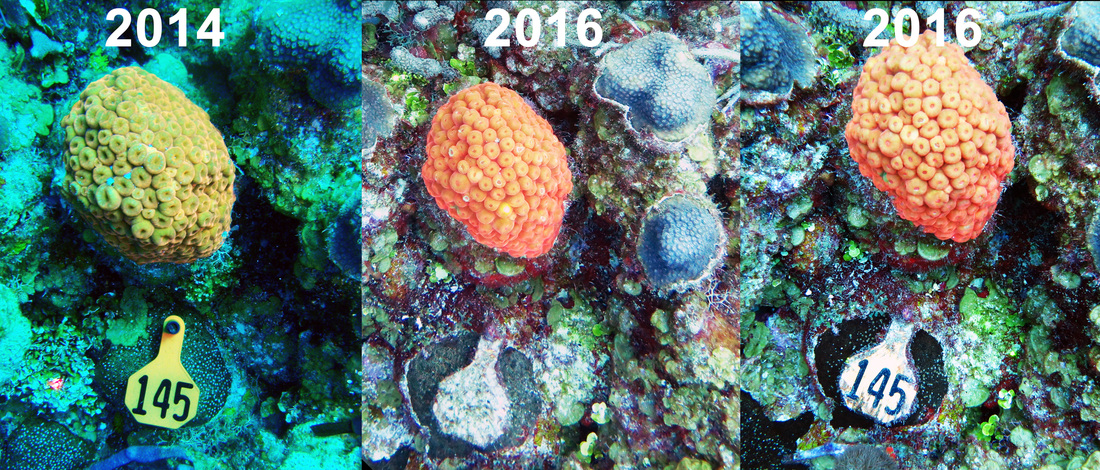 A timeline of an orange morph of Montastraea cavernosa tagged as #145. Photos from 2014, 2016 before tag cleaning, and 2016 after tag cleaning |
Archives
June 2024
|
 RSS Feed
