Dr. Joshua Voss and PhD Candidate Michael Studivan recently attended the European Coral Reef Symposium hosted by Reef Conservation UK at Oxford University. Both gave oral presentations, the abstracts of which can be seen below. In addition to attending exciting presentations about the world's leading coral reef research, they enjoyed the wonderful winter weather and rich history of Oxford. As the first official ECRS, the meeting was extremely well-attended, with over 500 registered attendees. It was also sustainably planned, with careful consideration given to reduce single-use waste and carbon emissions involved with conference travel.
Voss JD "Composition, Connectivity, and Symbiosis on Mesophotic Coral Reefs in the Gulf of Mexico and Northwestern Caribbean"
Abstract: Shallow water coral reefs of the Tropical Western Atlantic (TWA) are relatively well-studied with most, but not all, demonstrating declines in coral cover over the past 4 decades. Mesophotic coral ecosystems (MCEs) are also extensive in this region, but relatively fewer community characterizations or health assessments of these 30m to 150m deep reefs have been conducted. In multiple regions of the TWA, through the Cooperative Institute for Ocean Exploration, Research, and Technology, we have evaluated 1) the extent and composition of MCE resources, 2) evidence of coral connectivity across depths and distance, 3) corals’ algal endosymbiont assemblages, and 4) signs of coral health. MCEs exhibited lower incidence of disease or bleaching as compared to shallow reefs. However, their coral communities may be more dynamic than previously appreciated, including major losses of coral cover at Pulley Ridge on the West Florida Shelf sometime between 2003 and 2012. On a broad scale, populations of the depth-generalist coral Montastraea cavernosa demonstrate evidence of genetic connectivity across the entire Gulf of Mexico (GOM). However, Pulley Ridge appears to harbor relatively isolated coral populations. In the Flower Garden Banks National Marine Sanctuary, chlorophyll concentrations were significantly higher in mesophotic M. cavernosa due to an increased abundance of symbiont cells, which may represent a novel adaptation to light limitation at mesophotic depths. The results of this study and others indicate that mesophotic coral habitats in the GOM are more extensive and ecologically important than previously known, particularly with respect to supporting biologically diverse faunal assemblages and commercially important fish communities.
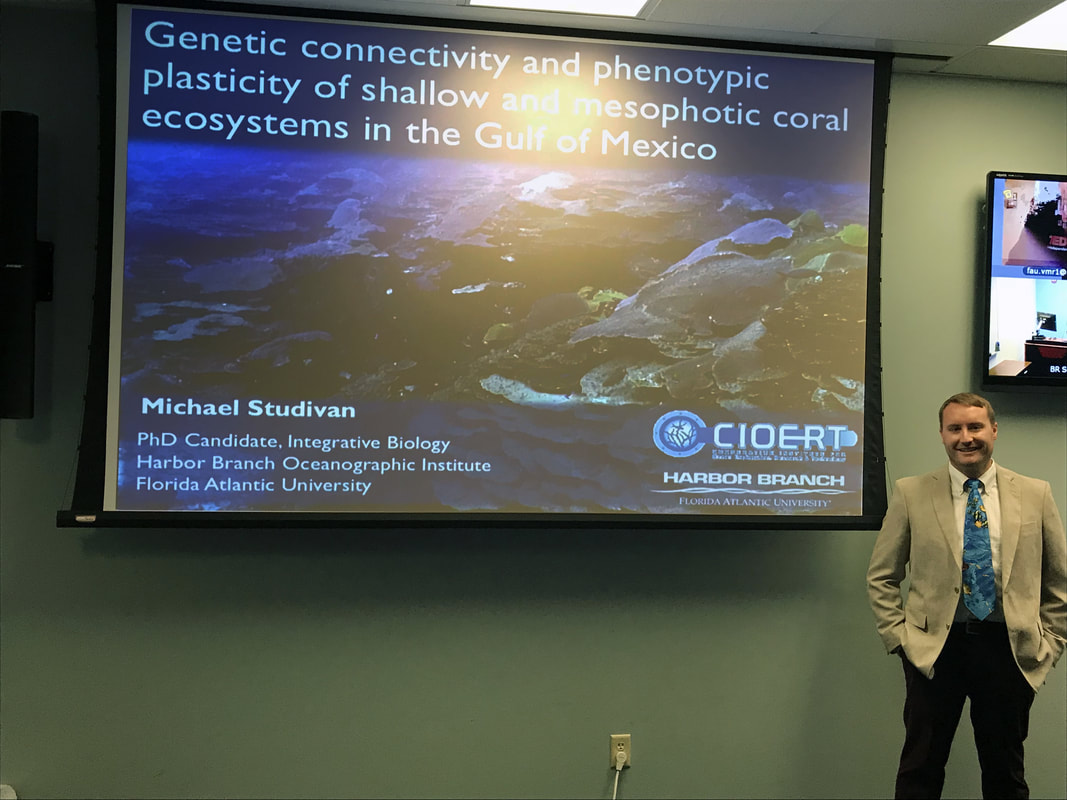
Studivan MS, Voss JD. "A depth of differences? Transplants and transcriptomic analyses of shallow and mesophotic corals"
Abstract: Mesophotic coral ecosystems (MCEs) comprise reef environments between 30-150m and in some cases have coral communities similar to those found on shallow reefs. Studies describing the extent and community composition of MCEs in the Caribbean have been informative, but there is a lack of understanding regarding the ecological roles of mesophotic corals and the functional differences among depth generalist conspecifics. This study was specifically designed in conjunction with an assessment of coral population structure to identify transcriptional variation of shallow and mesophotic Montastraea cavernosa in response to environmental gradients through a tag-based RNAseq pipeline. Gene expression profiling was conducted across four sites with relatively contiguous shallow and mesophotic habitats in the Gulf of Mexico and western Caribbean, including Carrie Bow Cay, Belize, West and East Flower Garden Banks, and Pulley Ridge/Dry Tortugas. Through assessment of basal gene expression across depth, we explore unique gene pathways that differ among shallow and mesophotic counterparts. Additionally, this study incorporated transplant experiments at West and East Flower Garden Banks to identify differences in gene expression following relocation across depth zones, and to determine how genotype contributes to environmental factors associated with depth. Ultimately, this research contributes to a better understanding how variation in genotype, gene expression, and algal symbionts contribute to flexibility of corals to different environments. This research is designed to provide data for improved regional management of deeper coral reef ecosystems and collaborative marine research with NOAA partners through the Cooperative Institute for Ocean Exploration, Research, and Technology (CIOERT).
Voss JD "Composition, Connectivity, and Symbiosis on Mesophotic Coral Reefs in the Gulf of Mexico and Northwestern Caribbean"
Abstract: Shallow water coral reefs of the Tropical Western Atlantic (TWA) are relatively well-studied with most, but not all, demonstrating declines in coral cover over the past 4 decades. Mesophotic coral ecosystems (MCEs) are also extensive in this region, but relatively fewer community characterizations or health assessments of these 30m to 150m deep reefs have been conducted. In multiple regions of the TWA, through the Cooperative Institute for Ocean Exploration, Research, and Technology, we have evaluated 1) the extent and composition of MCE resources, 2) evidence of coral connectivity across depths and distance, 3) corals’ algal endosymbiont assemblages, and 4) signs of coral health. MCEs exhibited lower incidence of disease or bleaching as compared to shallow reefs. However, their coral communities may be more dynamic than previously appreciated, including major losses of coral cover at Pulley Ridge on the West Florida Shelf sometime between 2003 and 2012. On a broad scale, populations of the depth-generalist coral Montastraea cavernosa demonstrate evidence of genetic connectivity across the entire Gulf of Mexico (GOM). However, Pulley Ridge appears to harbor relatively isolated coral populations. In the Flower Garden Banks National Marine Sanctuary, chlorophyll concentrations were significantly higher in mesophotic M. cavernosa due to an increased abundance of symbiont cells, which may represent a novel adaptation to light limitation at mesophotic depths. The results of this study and others indicate that mesophotic coral habitats in the GOM are more extensive and ecologically important than previously known, particularly with respect to supporting biologically diverse faunal assemblages and commercially important fish communities.
Studivan MS, Voss JD. "A depth of differences? Transplants and transcriptomic analyses of shallow and mesophotic corals"
Abstract: Mesophotic coral ecosystems (MCEs) comprise reef environments between 30-150m and in some cases have coral communities similar to those found on shallow reefs. Studies describing the extent and community composition of MCEs in the Caribbean have been informative, but there is a lack of understanding regarding the ecological roles of mesophotic corals and the functional differences among depth generalist conspecifics. This study was specifically designed in conjunction with an assessment of coral population structure to identify transcriptional variation of shallow and mesophotic Montastraea cavernosa in response to environmental gradients through a tag-based RNAseq pipeline. Gene expression profiling was conducted across four sites with relatively contiguous shallow and mesophotic habitats in the Gulf of Mexico and western Caribbean, including Carrie Bow Cay, Belize, West and East Flower Garden Banks, and Pulley Ridge/Dry Tortugas. Through assessment of basal gene expression across depth, we explore unique gene pathways that differ among shallow and mesophotic counterparts. Additionally, this study incorporated transplant experiments at West and East Flower Garden Banks to identify differences in gene expression following relocation across depth zones, and to determine how genotype contributes to environmental factors associated with depth. Ultimately, this research contributes to a better understanding how variation in genotype, gene expression, and algal symbionts contribute to flexibility of corals to different environments. This research is designed to provide data for improved regional management of deeper coral reef ecosystems and collaborative marine research with NOAA partners through the Cooperative Institute for Ocean Exploration, Research, and Technology (CIOERT).
 RSS Feed
