Restoration Team Trial: The largest experimental coral outplanting and restoration project in Florida to date
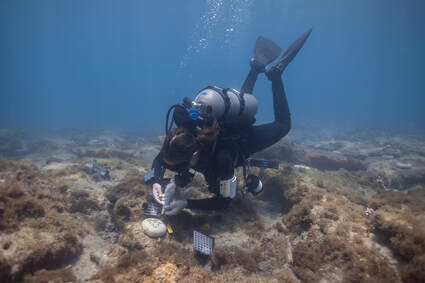
The Voss Lab has joined a new collaborative team to assess the feasibility of conducting restorations using coral species susceptible to stony coral tissue loss disease (SCTLD) along Florida's coral reef. Through this large-scale effort FAU Harbor Branch has partnered with Florida Fish and Wildlife Conservation Commission, Florida Department of Environmental Protection, Nova Southeastern University, Coral Restoration Foundation, Mote Marine Laboratory, University of Miami RSMAS Biscayne National Park, Reef Renewal, and Florida Institute of Oceanography at Keys Marine Laboratory. More than 1,100 coral colonies have been outplanted at 24 sites across Florida's coral reef from the most northern region in Martin County to Key West. The Voss lab is responsible for the outplanting and monitoring of the four most northern outplant sites, found on St. Lucie Reef and near Palm Beach. Three species of SCTLD-susceptible corals were chosen to be outplanted for this project; Orbicella faveolata, Pseudodiploria clivosa, and Montastraea cavernosa.
A photo album for this project can be found here: Coral Restoration Team Trials 2021
Site Preparation and Initial Outplanting
Beginning in April 2021, Voss Lab divers began to prepare the four selected sites for the outplanted arrays. This involved installing stakes and HOBO temperature loggers, conducting several surveys, as well as the coral base installations. Each outplant site includes 48 of custom bases set out in a 6 x 8 meter array and cemented to bare hard substrate using “Coral Anchor” underwater cement adhesive mortar by Reef Cells. After arrays at all sites had been prepped, the entire project team convened at the Keys Marine Lab in Layton, FL to conduct a massive coral swap led by the Florida Fish and Wildlife Conservation Commission (FWC). At the coral swap, more than 5,700 coral fragments were delivered from Mote Marine Lab, Reef Renewal, FWC, and the Coral Restoration Foundation. These coral frags were then divided up by FWC collaborators to distribute different species, genotypes, and sourced corals as evenly as possible to each outplanting team. Each outplanting team transported their allocated coral fragments to the various sites along Florida Coral Reef and outplanting was completed over the next few days. The Voss Lab team's coral fragments were successfully outplanted and have demonstrated excellent survival over the first few months of the project. At the coral swap, members of the Voss Lab also preserved samples from the majority of the coral genotypes to be used for later analyses- stay tuned!
Continued Monitoring
|
To track how the corals fare, each site is being monitored by divers on a monthly basis over the next two years. At each visit, scaled images of each colony are collected and the health status of each colony is recorded. Additionally, roving diver surveys are conducted to assess the disease status of other corals within the site. The goal of this experiment is to determine how these susceptible species respond to outplanting in the SCTLD endemic zone, where the majority of the highly susceptible species have died but evidence of the disease is still observed. This long-term study will provide insight for future management and restoration of SCTLD susceptible corals on Florida's coral reef.
|
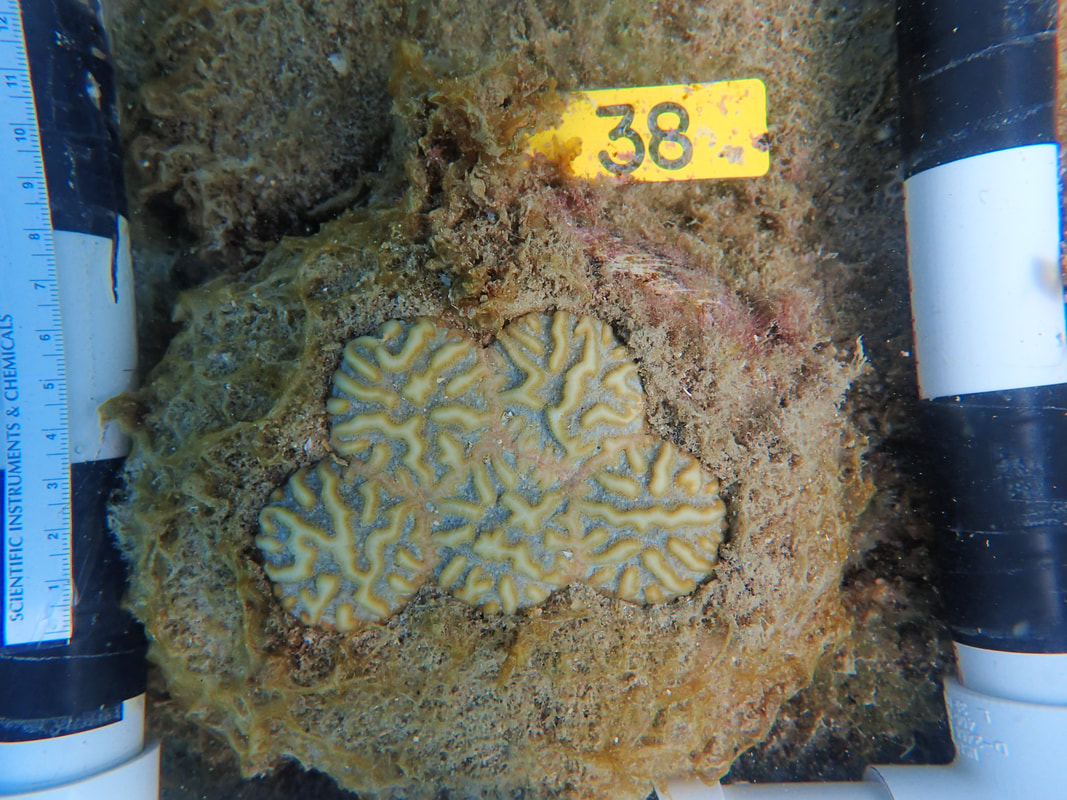
Colony of Pseudodiploria clivosa with all 5 fragments fused at the two month monitoring interval in July
|
Partners: The project is being led by The Florida Fish and Wildlife Conservation Commission and also includes partners at the Florida Department of Environmental Protection, Nova Southeastern University, Coral Restoration Foundation, Mote Marine Laboratory, University of Miami Rosenstiel School of Marine and Atmospheric Science, Biscayne National Park, Reef Renewal, and Florida Institute of Oceanography at Keys Marine Laboratory.
Funding: Florida Fish and Wildlife Conservation Commission, Florida Department of Environmental Protection
Links: Reef-wide outplanting of corals susceptible to stony coral tissue loss disease begins
Funding: Florida Fish and Wildlife Conservation Commission, Florida Department of Environmental Protection
Links: Reef-wide outplanting of corals susceptible to stony coral tissue loss disease begins
